Tracking Sharp Money: A Guide to Reading Exchange Data
Go beyond simple odds. Learn how professional bettor activity on exchanges shapes market lines, and how the SmartStake Smart Money tool surfaces this data.


In sports betting markets, most bettors rely on public opinion and intuition. Professional betting syndicates — "sharps" — operate differently, deploying significant capital and quantitative models. Their activity causes line movements that ripple through the broader odds market.
These movements are often invisible to casual observers. This guide explains how to read betting exchange data to understand where professional activity is concentrated. This is market analysis, not a guarantee of outcomes — results vary based on individual execution and market conditions.
Please note: Screenshots and examples in this guide are illustrative and taken at one point in time. They do not represent any individual user's results. Sports betting involves risk and is not risk free. Results vary based on market conditions, individual execution, and the sharp data used as a benchmark. Only use disposable income. SmartStake is not affiliated with any sportsbook.
The Market's Language: Betting Exchanges
To understand sharp footprints, it helps to look at where they are most visible: betting exchanges.
Unlike a traditional sportsbook (like FanDuel or DraftKings) where you bet against "the house," a betting exchange is a peer-to-peer marketplace. Think of it like a stock exchange. For every person betting on a team to win, there has to be another person on the other side of that transaction, betting on them to lose.
This simple difference is everything. On an exchange, the odds aren't set by a bookmaker; they are a direct reflection of the supply and demand between bettors. And because exchanges welcome winners and don't limit accounts like traditional sportsbooks do, they are the preferred hunting ground for the sharpest bettors in the world.
The Footprints of a Whale: Decoding Sharp Action
So, how does a sharp bettor—a whale—leave a footprint? Let's look at a real-world example from a game between the San Antonio Spurs and the Sacramento Kings.
On a betting exchange like Novig, a user is presented with an order slip. In this case, it shows a massive amount of money, nearly $12,000, is available to be bet on the San Antonio Spurs at odds of -329.
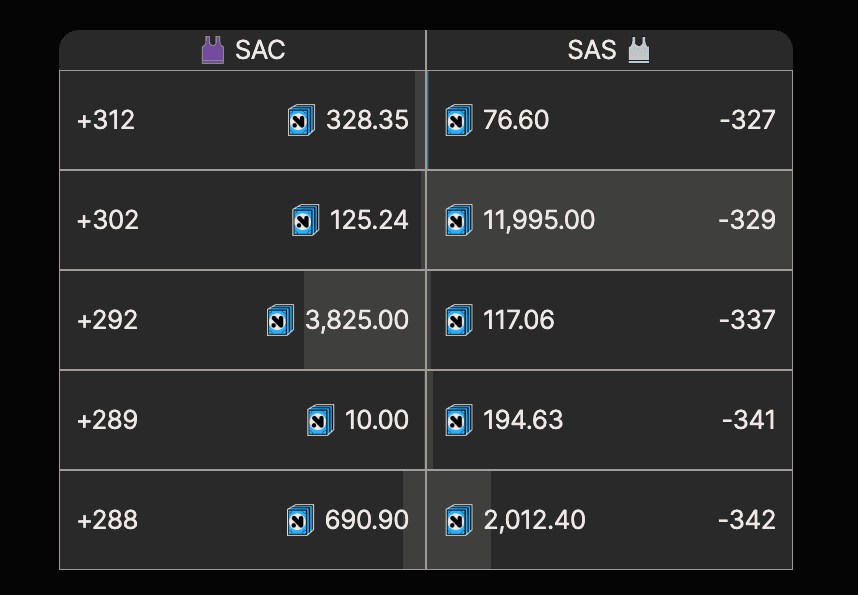
This isn't the exchange's money. It's another user's money. A sharp bettor is making an offer to the entire market: "I will let anyone bet on the Spurs at -329, and I will personally pay them out if they win."
Why would they do this? Because for every dollar they risk on the Spurs winning, they believe they have a better chance of winning the other side of the bet. By offering this bet on the Spurs, they are revealing their true position: they want to bet on the Sacramento Kings.
The offer to pay out at -329 on the Spurs is the inverse of the bet they are actually taking. They are effectively getting the Sacramento Kings at the implied odds of +329. This massive, publicly visible offer is the whale's footprint. It's a clear signal of extreme confidence from a professional.
Turning Signals into Strategy: Finding Your Edge
The footprint gives us a useful piece of data: a sharp, well-capitalized bettor believes that +329 is a price worth taking on the Sacramento Kings. SmartStake uses this as a benchmark — not a guarantee. Sharp bettors can still be wrong, and individual bets can win or lose.
The Smart Money tool tracks these liquidity signals across multiple price points, showing a wall of money from sharps wanting to bet on the Kings. The more money available, the more confident the sharps are.
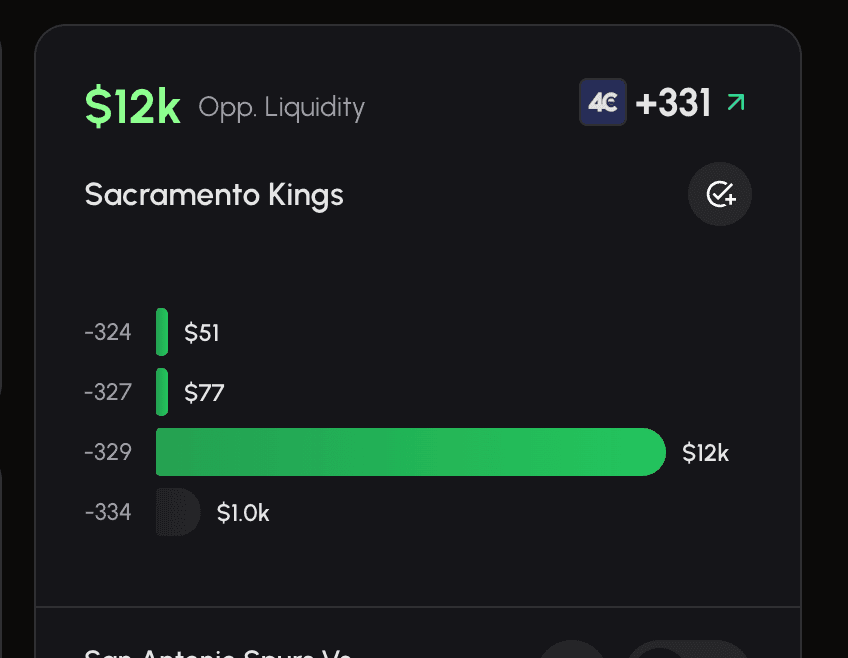
Now that you have this benchmark, the next step is to compare it against other sportsbooks. The Smart Money tool compares this benchmark price of +329 to the odds at recreational sportsbooks. In this example, another book, 4cx, is offering the Sacramento Kings at +331.
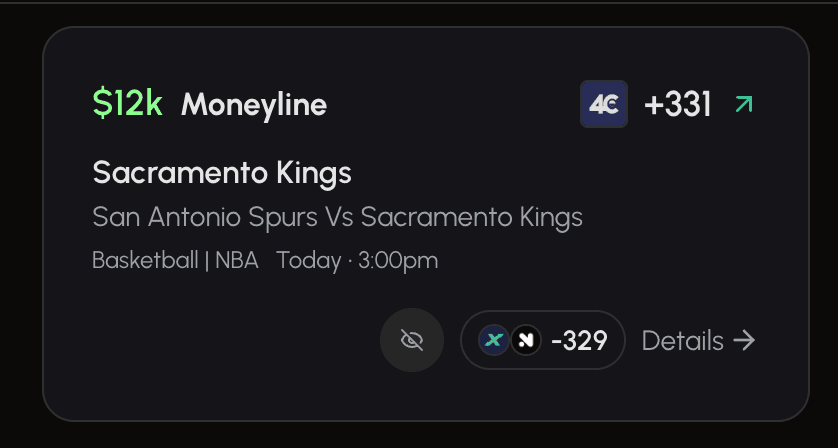
This is a candidate Positive Expected Value (+EV) bet. Here's the math:
- The sharp professionals were taking the Kings at +329 (a $329 profit on a $100 winning bet).
- The +331 line offered at the recreational book pays a $331 profit on a $100 winning bet.
The +331 line offers a slightly better price than what the sharps accepted. The logic is straightforward: when a recreational book is offering odds that exceed the sharp benchmark, the math suggests a candidate +EV bet. Sharps can still be wrong, individual bets can win or lose, and results are never guaranteed.
The Automated Edge: The Smart Money Tool
This theory has a practical problem: speed. These footprints appear and disappear quickly. Manually scanning exchanges, decoding the signals, and checking dozens of sportsbooks for a better price is impractical. By the time you find an edge by hand, it may be gone.
That's why SmartStake built the Smart Money Tool.
It automates this process. The platform scans betting exchanges, identifies the sharp footprints, and quickly compares their benchmark price against the major sportsbooks SmartStake tracks. When it surfaces a discrepancy—a place where the price exceeds the sharp benchmark—it lists the bet for your review.
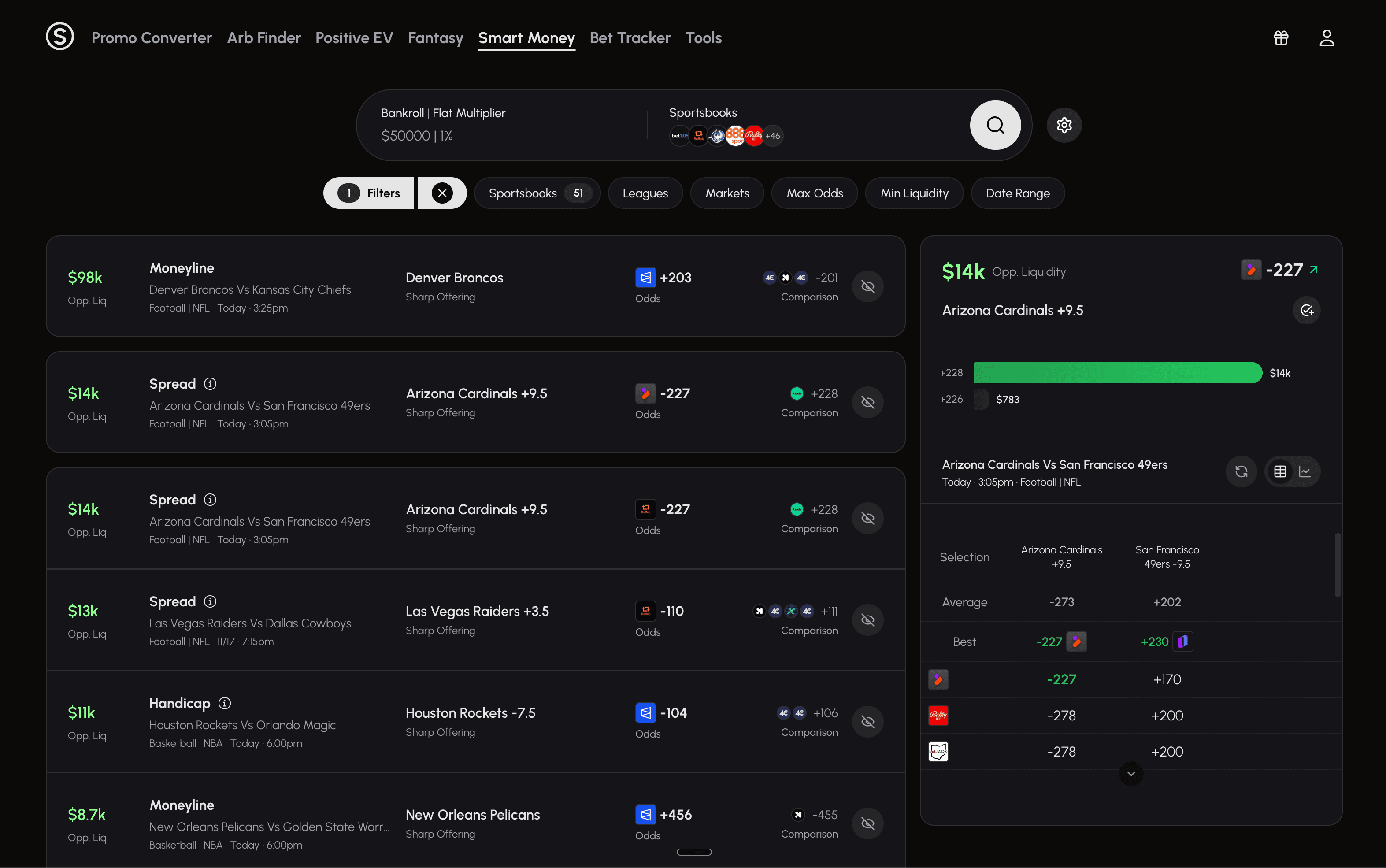
Instead of hunting for clues, you get a feed of candidate +EV betting opportunities to review. Individual bets can win or lose; results vary and are never guaranteed.
How to Use the Tool: A Practical Walkthrough
Now that you understand the theory behind following the whales, this video guide will walk you through the practical steps of using the Smart Money tool to find and place your bets.
Reading the Market
Looking for value in sports betting involves using public data to inform your decisions. Reading exchange movements gives you a window into how informed players are positioning. Sharp players can still be wrong, and individual bets can lose — results are never guaranteed.
The Smart Money tool surfaces the signals; what you do with them is up to you. Only use disposable income. SmartStake is not affiliated with any sportsbook and does not guarantee any specific outcome.
This content is for educational and informational purposes only and is not financial, investment, or betting advice. Sports betting carries risk and outcomes are never guaranteed — only stake what you can afford to lose, and bet responsibly.
Get the next guide in your inbox
Practical betting guides, new tools, and product updates from the SmartStake team. Unsubscribe in one click, any time.
By providing your email, you are consenting to receive communications from SmartStake. Visit our Privacy Policy for more info
Similar articles

FundamentalsSmart Money
What Is Sharp Money in Sports Betting? How to Follow It
A plain-English guide to sharp money: what a sharp bettor is, how professional action moves the market, and how to follow those signals into value with SmartStake's Smart Money tool. Results vary and are never guaranteed.
Jul 20, 2026 · 12 min read

TutorialsInsiders
How to Use SmartStake Insiders: On-Chain Sharp Money
A practical guide to SmartStake Insiders, the feed that turns Polymarket whale tracking into sportsbook Picks. Learn how a qualified Wallet becomes a Pick, why the board only shows you prices at or better than the Wallet's own fill, and what the recommended stake is really assuming about you.
Aug 7, 2026 · 12 min read

TutorialsPromo Converter
Promo Recommender: Which Sportsbook Promo to Take First
A practical guide to the SmartStake Promo Recommender, the screen that answers which sportsbook promo to take first. Learn why the queue is ordered by effort and then by the smallest face value rather than by expected value, what the bankroll rule is really gating, and why one book on your list never appears on the board at all.
Aug 7, 2026 · 12 min read