How to Use SmartStake's Lineup Dropper for MLB Props
Lineup Dropper watches MLB lineups as they post, shows every batter who moved off his projected slot, the prop markets that change, and which sportsbooks lag.

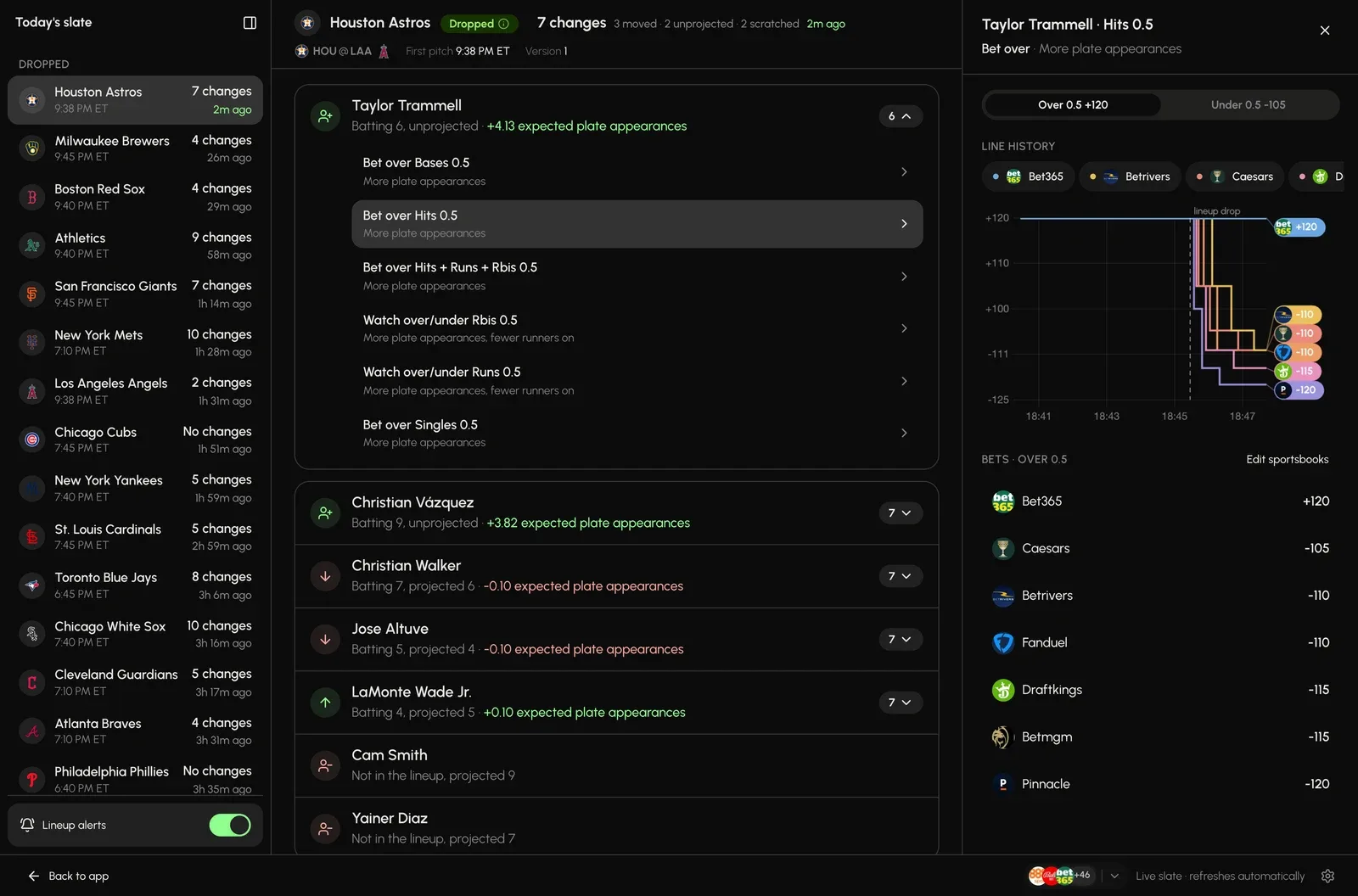
An MLB lineup card is public information for about a minute before it stops being interesting. In that minute a hitter the market had penciled in seventh is suddenly leading off, a regular is scratched, and the player prop markets built on their playing time are priced for a game that is no longer the game being played.
Lineup Dropper scans MLB lineup projections for those split-second changes and puts them in front of you while they still matter. It does not tell you what to bet. It tells you what changed, whose numbers it touches, and which sportsbooks have not caught up yet.
Please note: Screenshots in this guide are illustrative and taken on one slate. They are not anyone's results. Sports betting involves risk of loss and is not risk free. Prices move, limits are real, and a price you see is not always a price you get.
The Day's Wire
Open Lineup Dropper and you land on the newest lineup on the board, not on a list you have to click through. The day's slate runs down the left: Dropped at the top, newest first, On deck below it for the games still waiting, and Started at the foot for the games already underway. A lineup retires to Started at first pitch, because that is when the books pull the pre-game props it was priced against.
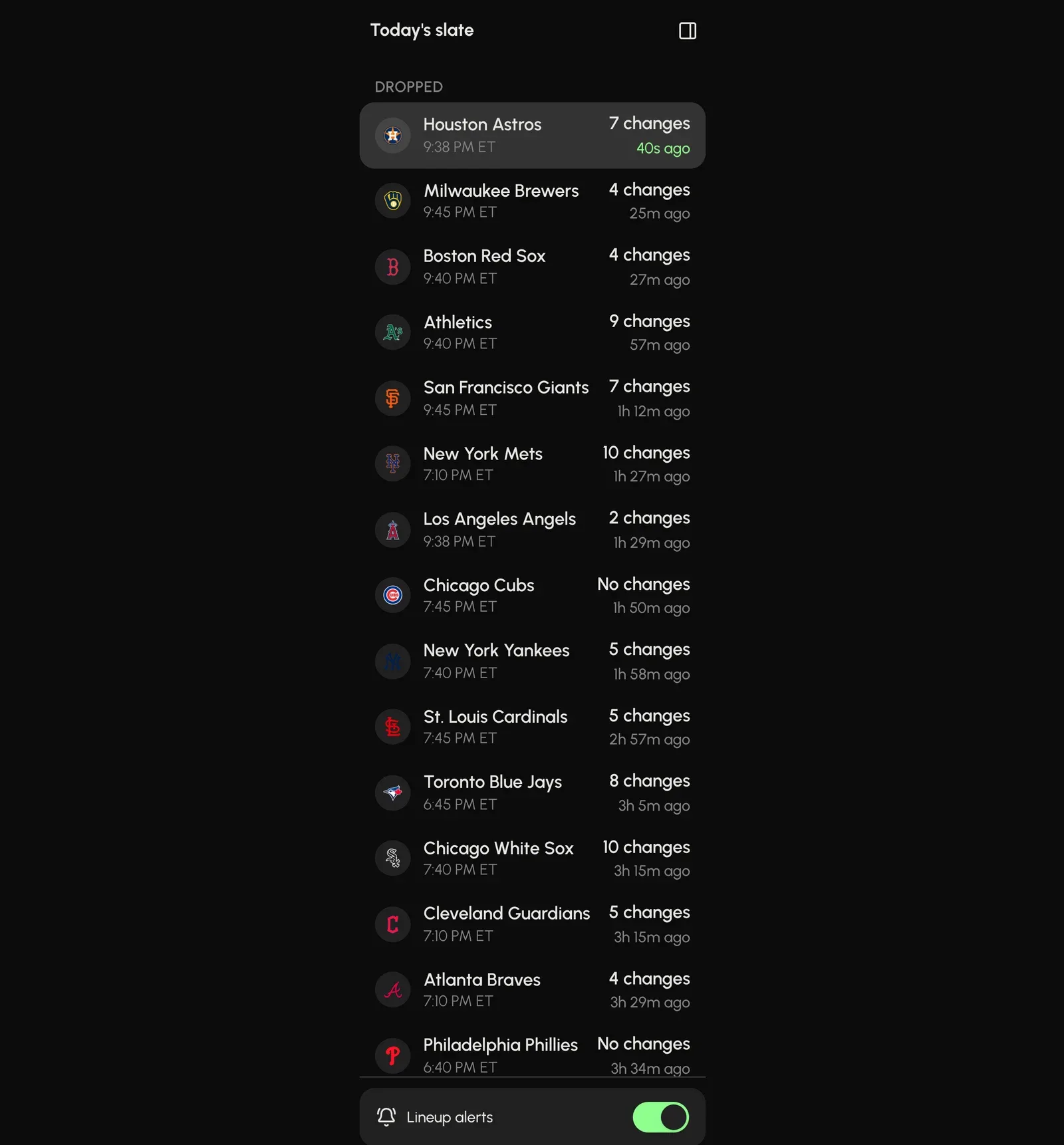
Each row carries the team, how many changes that lineup brought, first pitch, and how long ago it landed. The clock at the top of the wire is the whole point: forty seconds is a live situation, forty minutes is a history lesson. Click any row to read it.
If a team amends its lineup later - a late scratch, a reshuffle an hour before first pitch - that lineup jumps back to the top of the wire and its clock restarts. A scratch you learn about at 6:58 for a 7:05 game is worth more than the original card was.
Everything refreshes on its own. You never reload to see whether something dropped.
The Movers
A lineup that matches its projection is not news. What Lineup Dropper shows you is the difference: every batter in this lineup who is not where the market expected him to be.
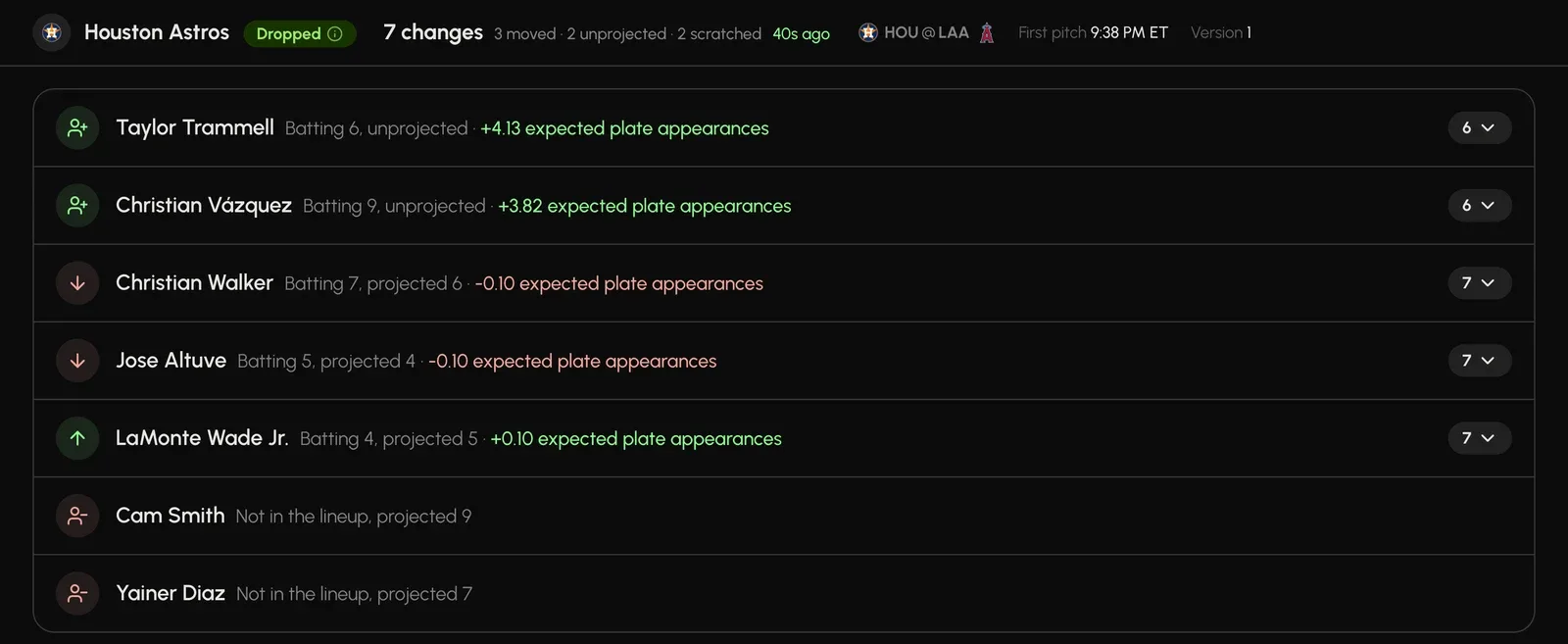
Three kinds of change show up:
- Unprojected starts. A batter who is playing and was not in the projection at all. Taylor Trammell above went from a night on the bench to batting sixth.
- Slot changes. A batter who is playing, but higher or lower than expected. Jose Altuve slid from fourth to fifth.
- Scratches. A batter the projection had in the lineup who is not in it.
Every mover carries what the change is worth in playing time, and the list is ordered by the size of that swing, so the biggest change reads first.
Why the Batting Order Moves a Prop Line
Baseball is a queue. The leadoff man hits first in the first inning and comes back around every time nine men have batted; the number nine hitter waits his turn and sometimes never gets a fifth one. Over a full game that ordering is worth roughly 4.65 trips to the plate at the top and roughly 3.82 at the bottom - close to a whole extra at-bat between the two ends of the card.
An extra trip to the plate is an extra chance at everything a hitter accumulates. Take a batter who reaches base with a hit in a little under a quarter of his plate appearances. Batting ninth he comes up 3.8 times and records at least one hit about two-thirds of the time. Move him to the top of the order and he gets 4.6 trips, and that climbs to roughly three-quarters. Nothing about the hitter changed. He just bats more.
That is the whole argument behind a lineup drop. More plate appearances argue the over on the counting stats a hitter piles up one at a time: hits, total bases, singles, hits + runs + rbis. Fewer plate appearances argue the under. A batter who was not in the projection at all and turns up batting sixth is the extreme version of this, going from no expected trips to four.
Open a mover and Lineup Dropper lists the markets his change touches, with the side the change argues and the reason in one line.
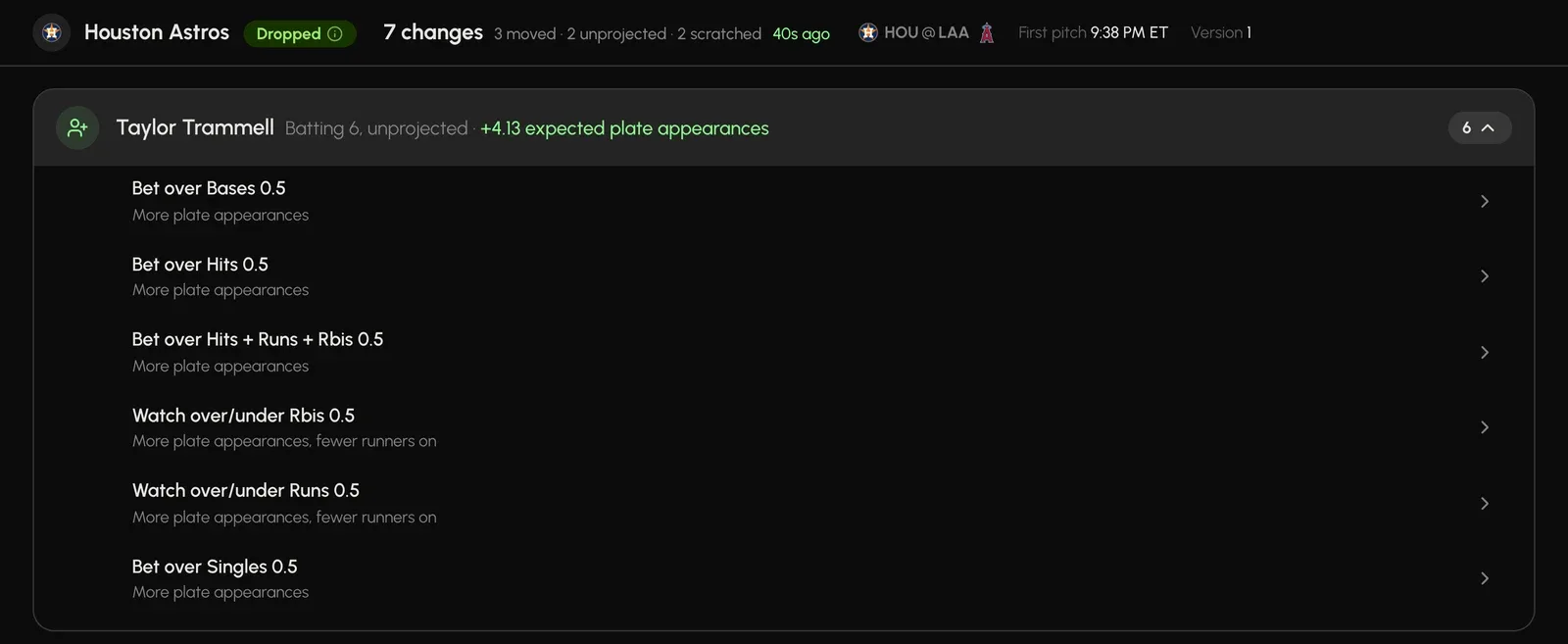
Two markets never get a side. Runs and rbis are marked watch, because they depend on the eight other men in the order as much as on the hitter himself. Move a man up the card and he gets more trips to the plate, but the weaker end of the order is now hitting in front of him, so he arrives with fewer runners on base to drive in. Move him down and he loses trips but inherits better hitters ahead of him. The volume and the company pull against each other, so Lineup Dropper flags the market and leaves both sides open rather than picking for you.
Which Books Are Slow to Move
This is the part that decides whether a change is worth anything to you. A lineup only pays if you can still find a sportsbook that has not priced it in.
Open a market and you get every sportsbook's price on that selection through the drop.
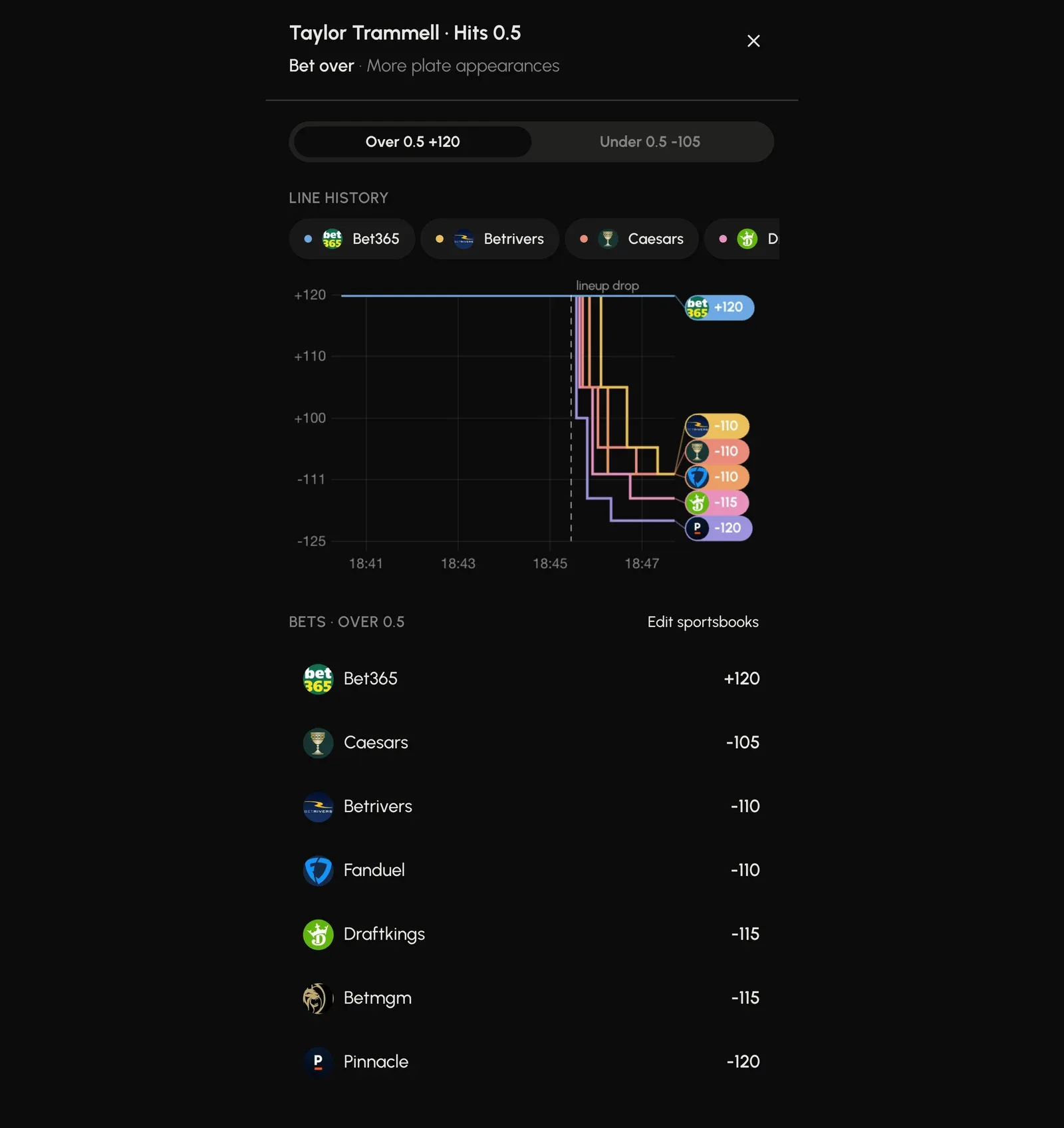
The window opens five minutes before the lineup landed and runs to right now, with the dashed marker on the drop itself. Each line is one sportsbook, and where a line ends is what that book is quoting this second - the same number its row carries in the list underneath.
Read it in two halves. Left of the marker, every line is flat: this is what the market thought the game was going to be. Right of the marker, the lines that step down are books that saw the lineup and repriced. In the shot above, five books walk the over from +120 down to somewhere between -110 and -120 inside the first minute.
One line does not move. It runs flat straight across the marker and out the other side, still quoting +120 - the number it set when this batter was not in the lineup at all. That book is not being generous. It is being slow, and it is now the only place on the board still paying the old price on a hitter the market did not expect to play at all.
That is why it sits at the top of the list underneath, where your own sportsbooks are ranked by their current price on the selection. Every row is a link straight to that selection at that book, so you leave for the price you are looking at instead of going and finding it again.
Which book is the slow one changes drop to drop, but the tendency behind it does not, and it has nothing to do with how big the book is. Measuring 6,659 market moves across a season, our lineup drops study found DraftKings and Caesars among the quickest to a usable price while bet365, Fanatics and PointsBet sat between one and four minutes behind the field. The chart is how you find out which one it is on the drop in front of you.
The panel carries both sides of the line. The Over and Under tabs each show the best price your books are posting on that side, and switching between them redraws the chart and the list. Tap a book's chip to take its line off the chart, or hover a book to pull it out of the pack.
Lineup Alerts
Nobody wants to sit on a page waiting for a lineup. Turn on lineup alerts and you get one push per drop, every side of every game and every amendment on top, seconds after the lineup posts.
They are off until you switch them on, and they are a wire rather than a tout: an alert says what happened, not what to do about it. The switch sits at the foot of the slate rail, and on the waiting room before the day's first lineup lands.
What the Timing Is Worth
Official lineups are published on the league's own feed. The account most of the market watches reads that feed and posts what it finds, and reading and posting takes time.
Across 158 lineup publications tracked in July, SmartStake had the lineup first about 92 percent of the time, with a median lead of roughly 38 seconds. The biggest gaps were much larger than that. Forty seconds is not much, but it is the difference between reacting to the race and starting it.
It is also worth knowing how often any of this pays. Across 2,917 lineup posts we measured, about half moved at least one prop market beyond the vig, and the typical one that did moved three markets at once by a little under three points of fair win probability. The other half landed roughly where the market expected and there was nothing to do. Knowing which half you are looking at, in the moment, is the job.
That study - how often a lineup drop moved a prop market, by how much, how long the slowest books took to follow, and how the head start was measured - is MLB Lineup Drops: The Two Minutes That Move the Market, published with the full dataset it was built from.
Getting Access
Lineup Dropper is part of Premium. One plan opens it and every other SmartStake tool - Positive EV, Smart Money, the Arbitrage Finder, the bet tracker - with no separate code, invite or add-on for it. See plans and pricing.
What It Will Not Do For You
Lineup Dropper is a news wire with the baseball arithmetic already done. It does not model a hitter, it does not price a market, and it does not tell you a bet is good. A batter moving up the order is a reason to look, not a reason to bet, and the frictions any experienced bettor knows still apply: books move fast, limits are real, and a listed price is not a guaranteed price.
What it removes is the part that is purely mechanical - knowing the lineup changed, working out whose numbers that touches, and seeing where each book stands on them - so the judgement is the only part left to you.
This content is for educational and informational purposes only and is not financial, investment, or betting advice. Sports betting carries risk and outcomes are never guaranteed — only stake what you can afford to lose, and bet responsibly.
Get the next guide in your inbox
Practical betting guides, new tools, and product updates from the SmartStake team. Unsubscribe in one click, any time.
By providing your email, you are consenting to receive communications from SmartStake. Visit our Privacy Policy for more info
Similar articles

Analysis
MLB Lineup Drops: The Two Minutes That Move the Market
A season-long study of MLB lineup drops and player prop markets: how often a drop repriced the market beyond the vig, which books caught up first, and how a head start on the league feed beats the Underdog tweet.
Jul 21, 2026 · 7 min read

FundamentalsOdds Screen
Run Line Calculator: What MLB's 1.5 Runs Are Worth
How to price baseball's run line from the moneyline, why roughly 3 in 10 MLB games land inside the 1.5 run band, and how the same trade works when you buy a half point in football or basketball. Results vary and are never guaranteed.
Jul 28, 2026 · 10 min read

AnalysisArbitrage
Sharpest Sportsbooks for MLB Player Props: 2026 Data Study
We studied over 600 million MLB player prop line movements and 1.3 million closing lines to rank which sportsbooks are actually sharp. Kalshi and ProphetX come out on top; Bookmaker and Pinnacle are the softest.
Jul 7, 2026 · 11 min read