NBA Betting Season Is Here
Why NBA season is prime time for +EV bettors: lineup volatility, the Lineup Dropper, deeper prop liquidity, same-game parlay pricing, and DFS correlation.
- Author
- Alex Bow
- Published
- Oct 20, 2026
- Read
- 9 min

We are really entering the best time of year for sports betting. NFL and college football are about a quarter of the way through their seasons, the MLB playoffs are still going, the NHL is just getting started, the NBA is here, and college basketball is right around the corner. More sports running simultaneously means more ground for the books to cover and more mispriced lines for us to take advantage of. And while I'm not the biggest NBA fan personally, I'm absolutely going to take advantage of the betting opportunities, because they're some of the best all year.
The most obvious reason is volume. The NBA plays 82 games per team, with multiple games every single night. Compared to the NFL, where each team only plays 17 games, the NBA just gives you so much more to work with. You can get action down every night of the week, and the sheer number of player props available is staggering. Points, rebounds, assists, steals, blocks, and then all the combos: Points + Rebounds + Assists, Points + Rebounds, Rebounds + Assists. Every game is a fresh opportunity to catch a book that hasn't adjusted.
Load Management and Lineup Volatility
Even compared to MLB, which has more than twice as many games, I still think the NBA creates better +EV opportunities. The main reason is volatility, meaning how quickly and dramatically the odds move. Line movement is your friend as a +EV bettor. The more prices shift, the more chances there are to catch a book that hasn't caught up yet or to recognize where the market is actually heading. A static market with everyone posting the same number doesn't give you much to work with.
What drives that volatility in the NBA, more than anything else, is lineup uncertainty. The league has become infamous for star players sitting out during the regular season for load management, and on any given day you genuinely don't know who's going to be in the lineup until it's announced in the afternoon.
Here's why that creates real opportunity. Say the books have Jalen Brunson's points line posted at 25.5 in the morning. His coach decides to rest him. Someone else has to score those points. The game total isn't going to drop by 25 points just because Brunson is out, it might come down a point or two, but all those buckets now get redistributed. Karl-Anthony Towns' line moves up. OG Anunoby's line moves up. Mikal Bridges' line moves up. Their rebound/assists lines move, their combined lines move, and every single one of those adjustments creates a window where some book somewhere is slower than the others to reprice.
The Lineup Dropper Tool
SmartStake launched the Lineup Dropper tool during the MLB season, and the premise is exactly right for NBA. The tool flags player props that appear mispriced after lineups are announced, catching spots where a book hasn't fully adjusted to the new information.
In MLB, lineup position matters. Batting first versus ninth changes your expected plate appearances, which ripples through hits, total bases, RBIs, and basically any counting stat. The Lineup Dropper was built to catch those windows before they close.
But I think the NBA is going to show what this tool is really capable of. MLB lineup changes move lines slightly. NBA lineup changes can move them dramatically, across multiple players at once. A single star sitting out touches every prop for every other player on the team, sometimes even the other team (ex. if KAT is sitting against the 76ers, Embiid’s rebound line could increase). I'm genuinely curious to see how the tool performs in this environment, because the opportunities are more frequent and more significant than anything we saw during the baseball season.
Coming soon
The NBA News Dropper, the NBA counterpart to the Lineup Dropper, is coming very soon. Follow @smartstakeapp on X so you don't miss the announcement.
Liquidity and Pricing Quality
The other thing that makes NBA player props so attractive right now is the depth of the market. More people bet on NBA than MLB for player props, which means more pricing models, higher limits on sharp books, and better liquidity on prediction markets. For MLB, the really liquid props are mostly home runs and pitcher lines. For the NBA, almost every major counting stat gets serious attention.
Better liquidity means better confidence in your fair value calculations. More data points, more participants pricing the market, less noise. And prediction markets have gotten significantly more liquid and sophisticated since last NBA season ended. Novig and ProphetX have both received CFTC recognition since then, which brings more participants and more capital into the order books. During the MLB playoffs we were already seeing things like $300,000 in liquidity on a single pitcher strikeout line on prediction markets. I can only imagine what those order books are going to look like for NBA player props once the season gets going.
A Warning on Same-Game Parlays
One thing worth addressing, because you're going to see it constantly throughout the NBA season, is same-game parlays. Sportsbooks push SGPs hard with daily boosts, and the NBA is the sport where this is most aggressive. You'll see them everywhere. Most of them are not good bets, and it's worth understanding why.
When you place a same-game parlay, the book is pricing in the correlation between your legs, and they are not doing you any favors when they do it. If you parlay any two legs from different games that are both priced at −110, you will always get +264. That's just the math of combining two independent −110 legs. But if those two legs are in the same game, you'll get lower odds than that, because the book is charging you a premium for the fact that they're correlated.
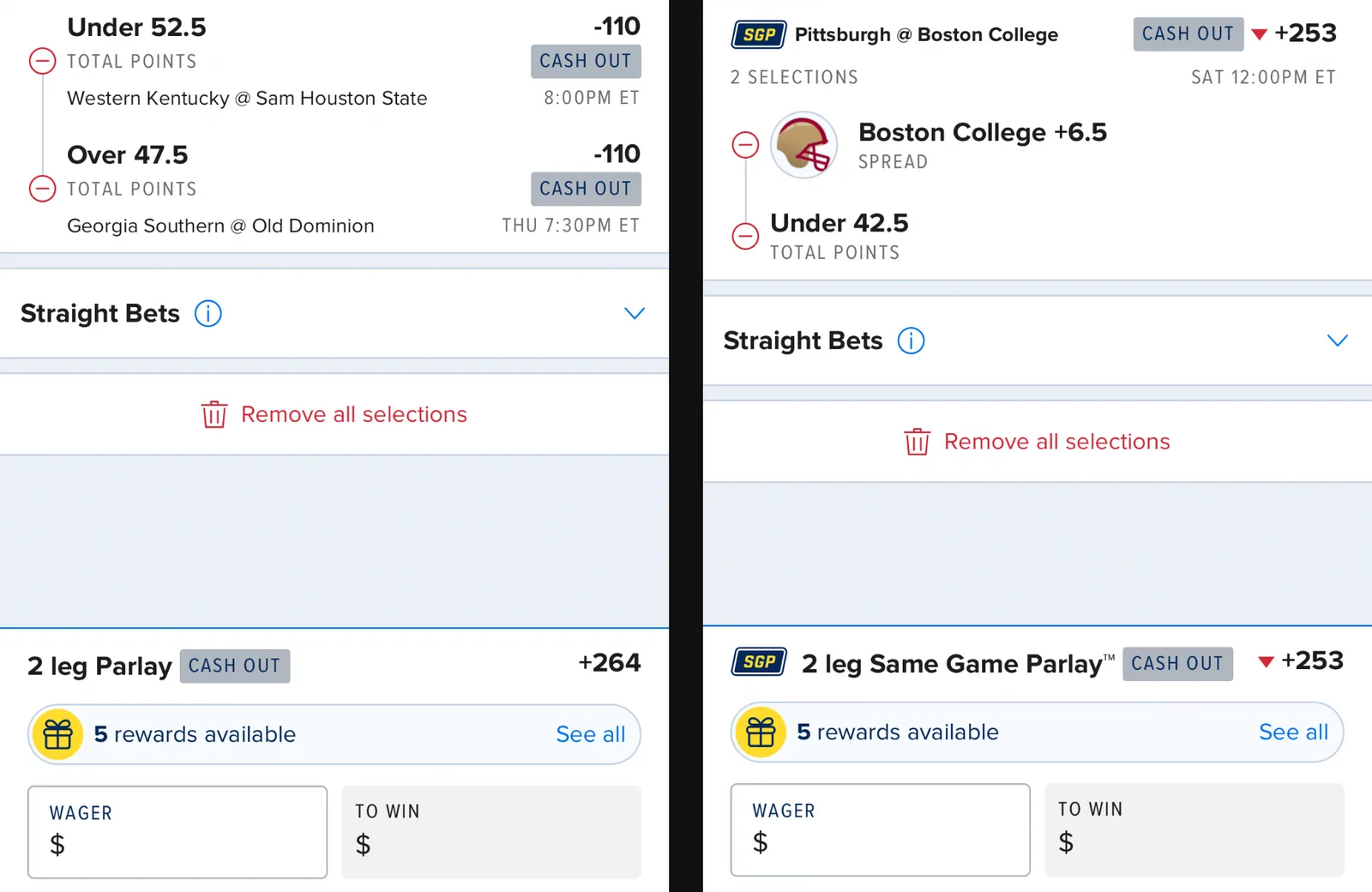
As you can see in the example, the two-leg parlay from different games comes out to +264. The same-game version at +253 looks like a small difference, but this is a clean, conservative example. For player props specifically, where you're already dealing with one-way markets and a higher vig to begin with, that correlation penalty can get more significant. The book is adjusting for correlation you can't see the other side of, because they're not going to show you what they think the SGP should price at. Yes, taking correlated legs will increase the chance of the overall slip, but the book will never give you close to fair odds (or even standard vig odds) as they will always overcompensate for correlation to make the bets more profitable for themselves.
The boosts help, but not as much as people think. A 25% or 30% SGP boost sounds good, but depending on the legs you're combining, the correlation adjustment the book bakes in can eat most of that boost and leave you at negative or flat EV. I really don't use SGP boosts unless they're in the 50% to 100% range, where the boost is big enough that it doesn't matter much what's in the parlay. If you're going to use one, check the EV on SmartStake before you place it. A lot of the standard daily boosts won't look nearly as good once you actually run the numbers.
DFS Season
The other reason I look forward to NBA season is that it's also DFS season, at least for me. I know some people play Prizepicks, Underdog, Pick6, and similar apps year round, but I find the NBA the easiest to beat, and a big part of that is the same reason we talked about above: there are so many props, and they're deep, two-sided markets with real liquidity behind them.
For MLB on these apps, you mostly get pitcher props and some home run and total bases lines, and a lot of those are one-way markets with compressed odds. In general, you want to focus on markets where both the over and under are available and you can actually evaluate both sides.
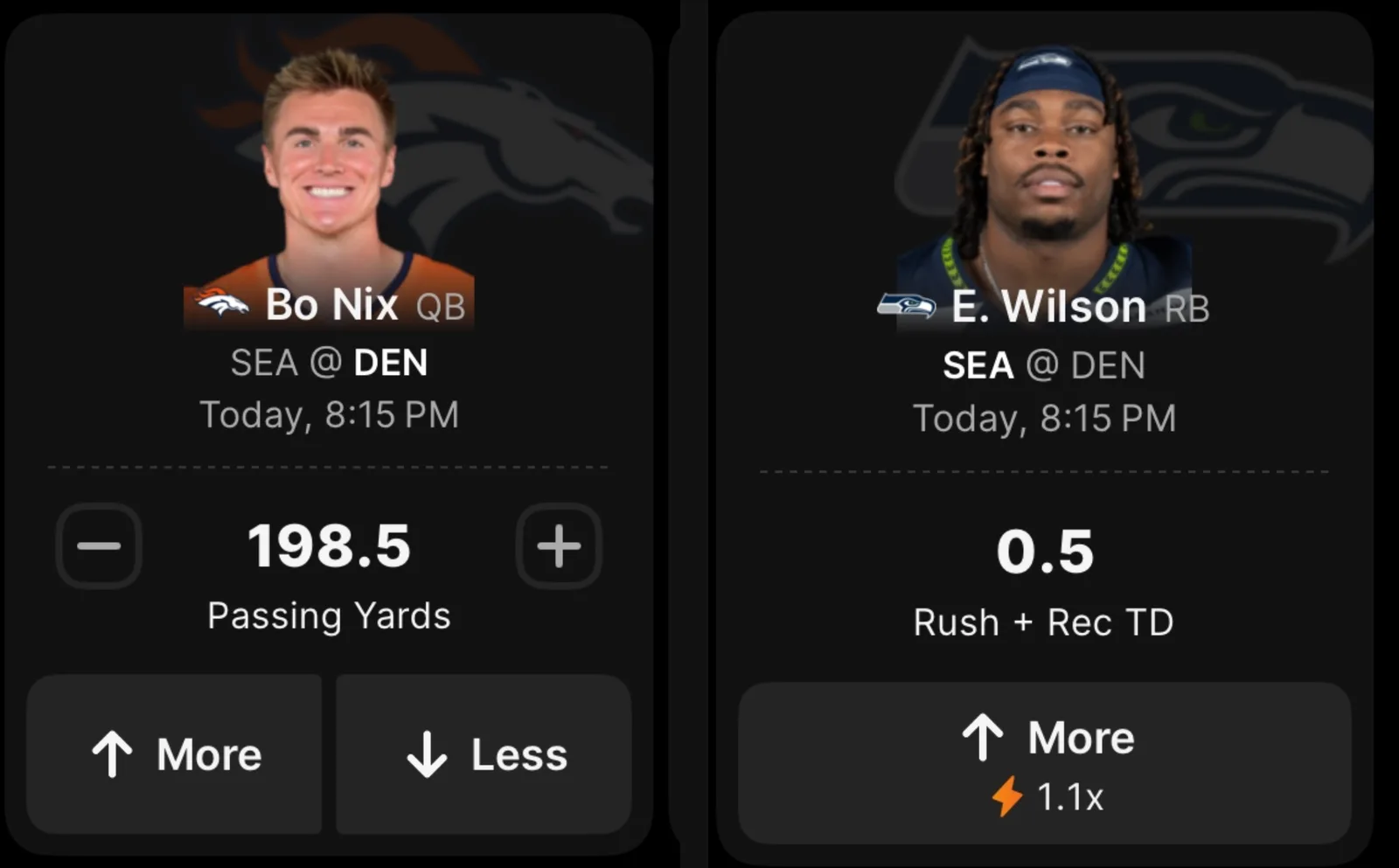
The left image is what you want to see on a DFS site. A standard over/under market with balanced odds on both sides. When you build a 3-leg Pick6 slip at 6x, you're getting roughly −122 on each individual leg. Now look at the right picture. The 1.1x multiplier on the Emmanuel Wilson ATD leg sounds like a bonus, but run the math: it bumps your 6x slip up to 6.6x. Work backwards and that 1.1x boost implies you're getting about +100 on the Wilson leg specifically. Meanwhile, Wilson's TD is sitting at +120 on any standard sportsbook and that's with vig. His fair value is probably somewhere between +125 to +130. You’re leaving 25-30 cents on the table on this leg. That's the trap with one-way markets on DFS sites. There's no under to balance it out, so the platform sets the price however they want, and the multiplier makes it feel like you're getting a deal when you're actually getting worse odds than you'd find anywhere else.
The other thing that makes NBA DFS so good is that you can actually use correlation to your advantage. If you bet Jalen Brunson over points and OG Anunoby under points in the same parlay on Prizepicks, those legs are positively correlated. The more shots Brunson takes, the more likely his over hits, and the fewer shots there are available for OG, making his under more likely to hit as well. There's only one ball. For every shot Brunson takes, both legs are moving in the right direction at the same time.
The caveat is that these apps aren't completely unaware of this. On a standard 2-man parlay you might get 3x payout. But if they detect that your legs are correlated, they'll sometimes adjust it down to 2.7x or similar. In that case they're pricing in the correlation, and the parlay might not be +EV anymore. So if you're building correlation slips, make sure the payout isn't being adjusted, or if it is, make sure the adjustment is small enough that it doesn't erase the edge. I made nearly half my NBA profits last year on Pick6 alone just from correlation slips. These apps have gotten sharper, but the opportunities are still there. And the SmartStake fantasy tool will do the optimal slip size math for you so you're not leaving EV on the table by picking the wrong payout structure.
The Closing Line
Each sport has its own niches, and the more time you spend in the markets the more clearly you start to see them. It's not always about having better judgment when reading a line. A lot of it is just recognizing where the windows actually open in a specific sport and being positioned to take advantage when they do.
For the NBA, the two places I've personally found the most consistent success are lineup news and DFS correlation. Those are the spots where the books and the apps are consistently a step slow, and where putting in a little extra attention pays off more than just running the EV tool on random props.
Will this season look exactly like last year? Probably not. What worked last year won't work forever, and the books and apps do get sharper over time. But the process of looking for things like this, noticing patterns, and finding your spots, that part doesn't change. It's less about following a formula and more about staying curious and staying creative. The edge is always somewhere. You just have to find it.
Alex Bow
Alex Bow trades tennis and baseball markets on Kalshi and Polymarket and writes about prediction market structure for SmartStake.
Every issue of The Closing Line →Subscribe / Weekly
Get the next issue in your inbox, before the line moves.
Free, unsubscribe anytime. By subscribing you agree to receive emails from SmartStake. See our Privacy Policy.